Our Elites Just Suck - Episode 1
The Root Cause of the Sri Lankan Crisis
Root Cause Analysis
I will preface by saying that this article is the source material for this video essay. To find the root cause of any problem, business and engineering students are thought to perform a simple root cause analysis. Since this is a socio-economic issue, we selected the 5 Whys Technique. We start with the problem : in this case Sri Lanka’s political crisis. Subsequently, we ask ourselves why, 5-7 times until we arrive at the root cause of the problem.
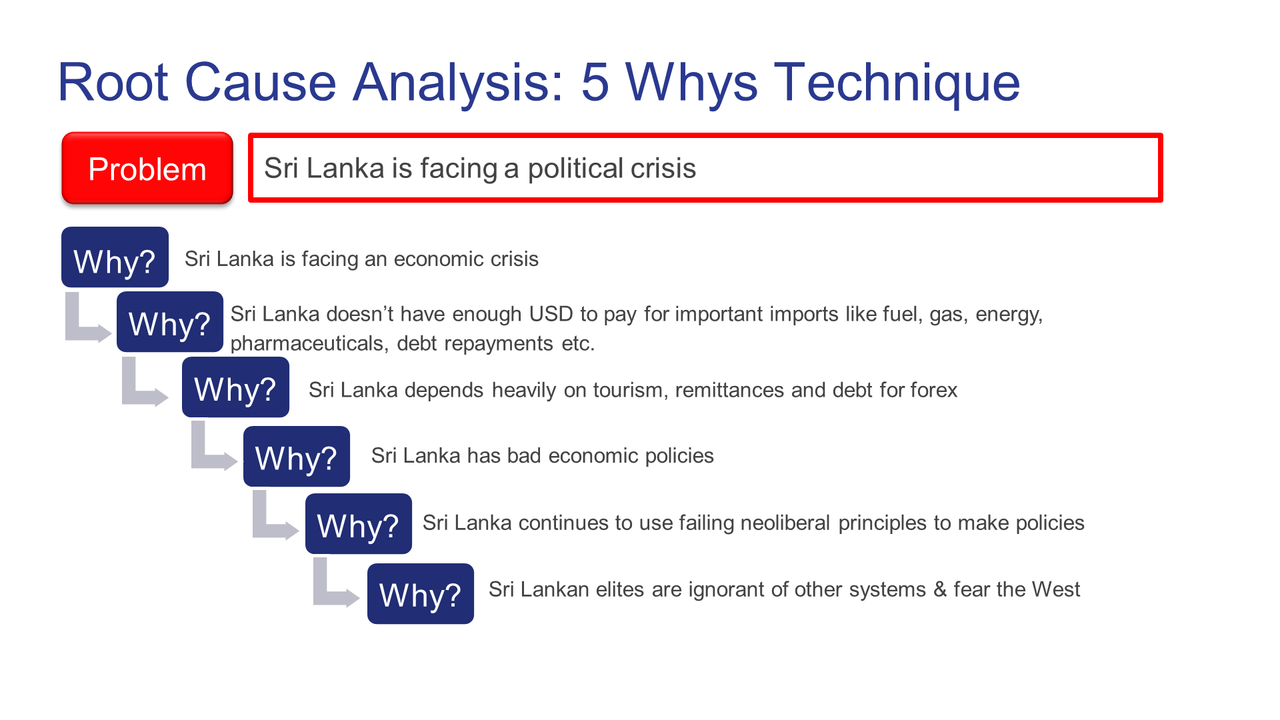
Based on the root cause analysis we performed, the prime causes that led to Sri Lanka’s current economic turmoil can be narrowed down to these 3.
- Neoliberal Policies: Pursued by ALL regimes since JR’s time, made us dependent on the volatile tourism and service sectors to generate much needed USD, due to the death of many local manufacturing industries (usually more resilient to external shocks)
- Energy Cost: Sri Lanka’s GDP growth is tightly bound to access to cheap energy.
- Gross Incompetence: Plus corruption has led to the pursuing of bad policy decisions. Too much focus by elites on politics, rather than governance.
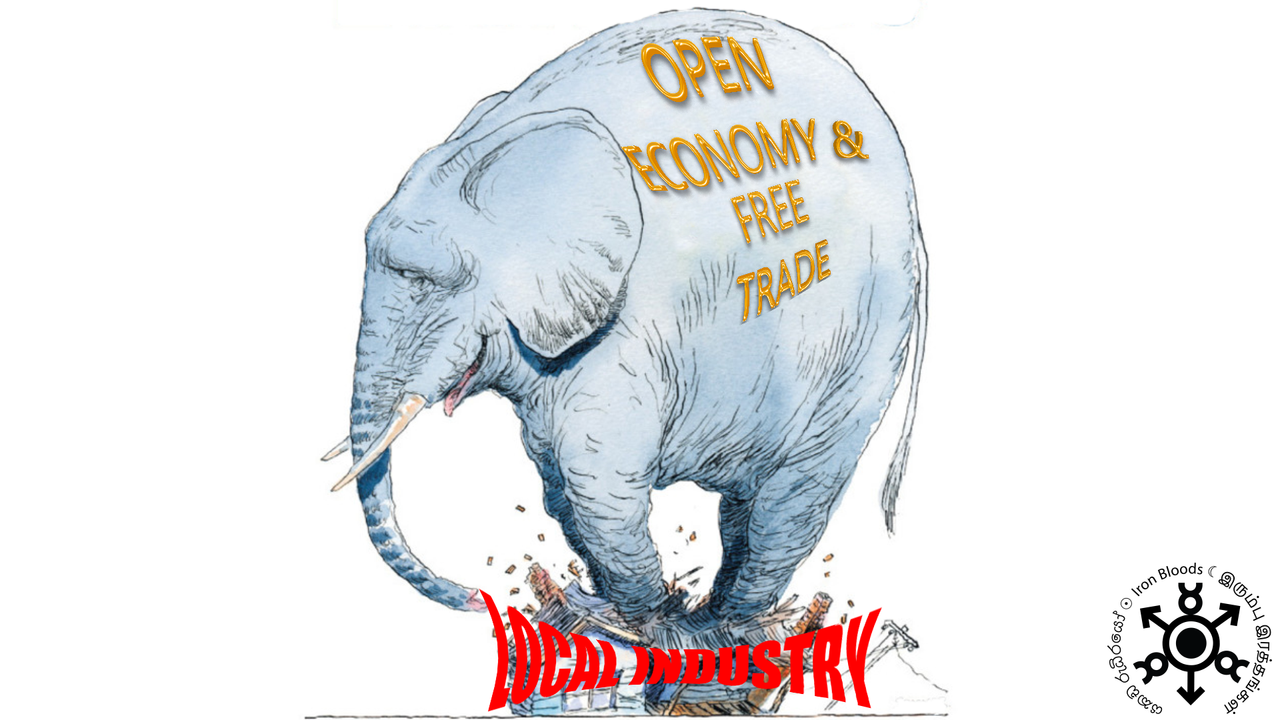
However, we will focus on the root cause of Sri Lanka’s crisis. That root cause is the Neoliberal policies that Sri Lanka implemented since 1977 when JR Jayawardene became the first president. These policies have been pursued by both left and right wing parties when they eventually came into power.
Pursuing these policies meant the death of the manufacturing economy and eventually Sri Lanka became much more reliant on volatile sectors like tourism to bring in foreign currency. As we dive deeper into how neoliberal policies affected Sri Lanka, you will understand why I named this series “Our Elites Just Suck”. I would venture to say that neoliberalism has been a dead end since the day it was implemented in this country. Our elites suck because they are trying to solve the problems caused by neoliberalism, using neoliberalism. This paper1 by Professor Lalith elaborates that rather than solve our problems it is bound to add fuel to the fire.
There are a million explanations all over the web on neoliberalism. Frankly I don’t care what the definition of Neoliberalism is to various people and institutions. I am more interested in the effects it has on nations that decide to implement it 2
- Nations that do usually have extensive deregulation which leads to death of local industries (does this sound familiar to anyone? Hint: this is exactly what happened in Sri Lanka after 1977 when when small business owners lost their livelihoods)
- They embrace globalism, western values and western culture.
- They privatize their State Owned Enterprises and national assets. (again, does this sound familiar to anyone? Hint: this is exactly what happened in the early 2000s when Chandrika Bandaranayake was in power. The regime either sold, privatized and shut down SOEs following the doctrine. This is also the same thing Ranil Wickramesinghe wants to do right now in late 2022, with all the talks of privatizing even profitable enterprises like Sri Lanka Telecom.)
This is a direct use of the ‘D-L-P Formula’: (1) deregulation (of the economy); (2) liberalization (of trade and industry); and (3) privatization (of state-owned enterprises). Related policy measures include massive tax cuts (especially for businesses and high-income earners); reduction of social services and welfare programmes; replacing welfare with ‘workfare’; use of interest rates by independent central banks to keep inflation in check (even at the risk of increasing unemployment); the downsizing of government; tax havens for domestic and foreign corporations willing to invest in designated economic zones; new commercial urban space shaped by market imperatives; anti-unionization drives in the name of enhancing productivity and ‘labour flexibility’; removal of controls on global financial and trade flows; regional and global integration of national economies; and the creation of new political institutions, think tanks, and practices designed to reproduce the neoliberal paradigm 2 (Stegler and Roy, 2010, p.14)
As the economist Dr. Ahilan Kadirgamar says, “[Sri Lanka] was the first country in South Asia to undergo structural adjustment and be set on a neoliberal trajectory. Those economic changes brought about by the JR Jayawardena government, locally called the ‘open economy reforms’, were pushed through with authoritarian power used not just for repression of minorities, but attacks on trade unions and the Left more broadly.”
JR implemented these policies to ruin the power of unions 3&4, and his protege Mr Wickramasinghe is known to have an adversarial relationship with Unions. If you check YouTube for his latest parliamentary speeches, he continually attacks unions and advocates removing legislation that provides job security to Sri Lankan employees.
Effect of NeoLiberalism in Sri Lankan BOP Management
Let’s get into the meat and potatoes, shall we? How has the neoliberal doctrine affected Sri Lanka’s balance of payment management. As many of you may know, balance of payments is the amount of money or wealth entering and exiting a country in a year.
When balancing a nations’ payments, even Advanced Level students in Sri Lanka pursuing commerce subjects know that there are 2 main accounts that matter.
- The Current Account
- The Capital Account.
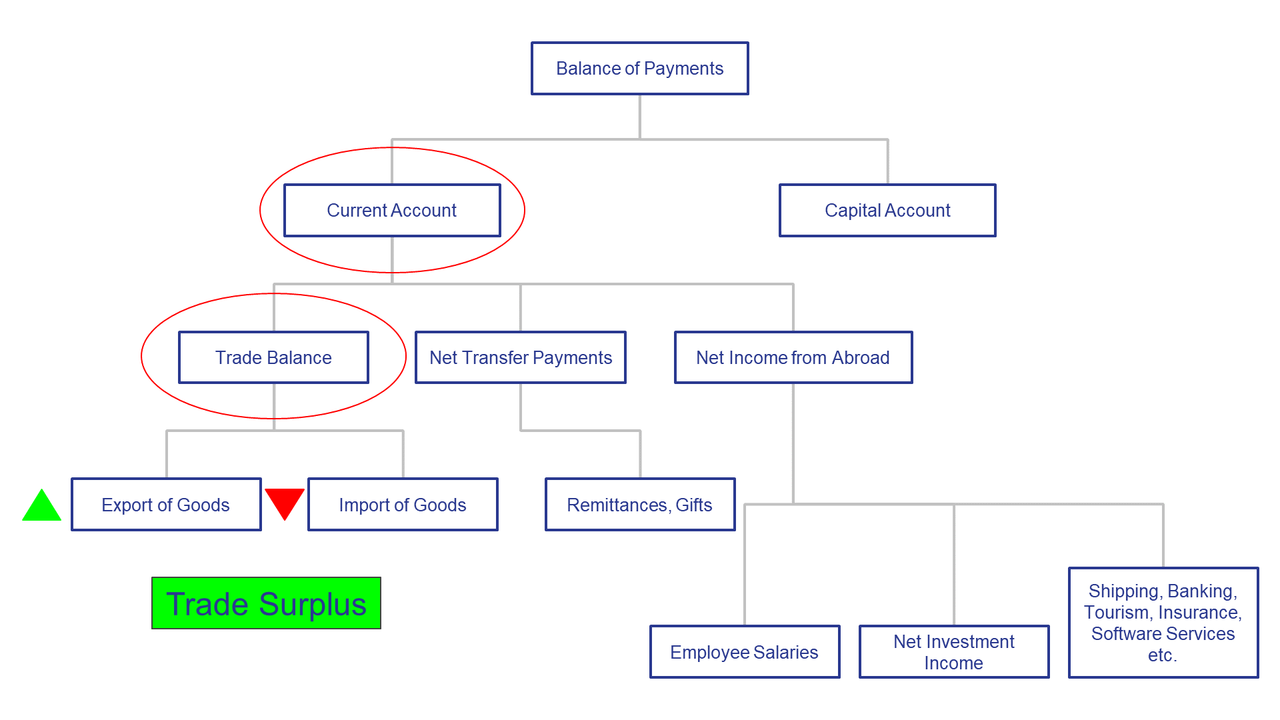
For now let’s focus on the current account.
The most important things to pay attention to here are the
- Trade balance
- Remittances
- Investment income.
Trade Balance
Simply means the difference between the value of imports and exports. So as long as exports bring in more foreign currency than what imports cost us, we’re good. If you remember, remittances was another way that Sri Lanka gained foreign currency which dried up along with tourism, when COVID-19 hit.
If the income we get from exports is higher than the cost of our imports, we have a trade surplus.
If the income we get from exports is lower than the cost of our imports, we have a trade deficit. This is simple Advanced Level economics.
Research shows us that5, when it comes to Sri Lanka, any increase in our deficit causes an increase in our exchange rate. That means the Sri Lankan rupee depreciates against the US dollar, making the dollar more expensive.
According to Neoliberal theory, a depreciation in the Sri Lankan rupee against the US dollar should reduce the cost of our exports and increase their demand, theoretically solving the deficit issue. However the keyword here is theoretically. In reality this is not always the case. Just because our exports become cheaper, doesn’t mean there will be more buyers for it. The purchase of some goods doesn't depend on price, for example specialized mechanical parts and computer technology. Perhaps other nations that purchase our products too are having economic slowdowns and cannot afford to purchase anymore. Perhaps that is all the market needs. Many things influence the income generated from exports, apart from exchange rate.
Let us assume a nation dogmatically follows neoliberal policies causing a continual trade deficit. What happens to a nation that continuously runs a trade deficit and a resulting current account deficit for around 45 years? Remember our A-Level Economics classes! A trade deficit is when income from exports exceeds the expenses of imports. When a nation continuously runs a trade deficit, its foreign reserves decrease because it is using these to pay for imports. The only option left is to borrow foreign currencies to pay for imports.

This graph is a history of our foreign reserves since the 1970s. Ideally since Sri Lanka has been running a Current account deficit since 1977, our foreign reserves should decrease, correct? However we can see sudden spikes in our foreign reserves around 2007. Isn’t this curious? How could this be?
Looking at our trade deficit again, there has been no change, so how has our foreign reserves increased?
A Debt fueled party of “Growth”
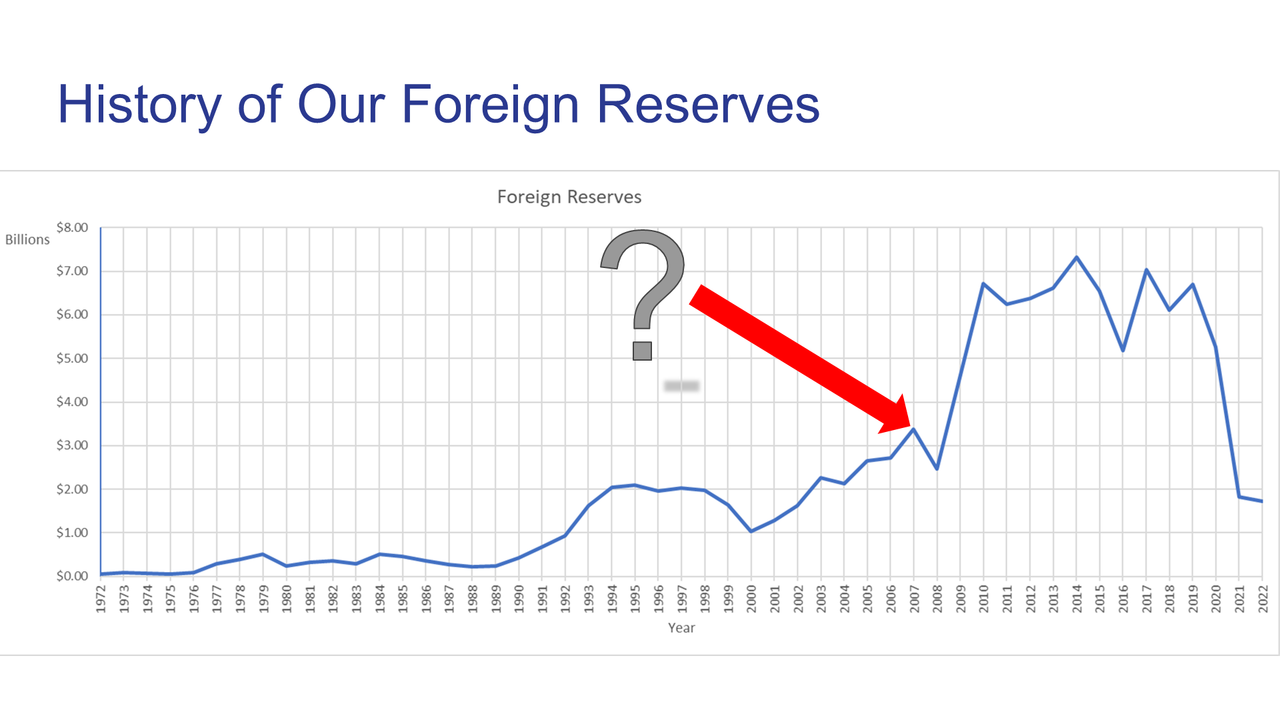
Let’s zoom in to this curious area of the graph and see if we can learn any more information.
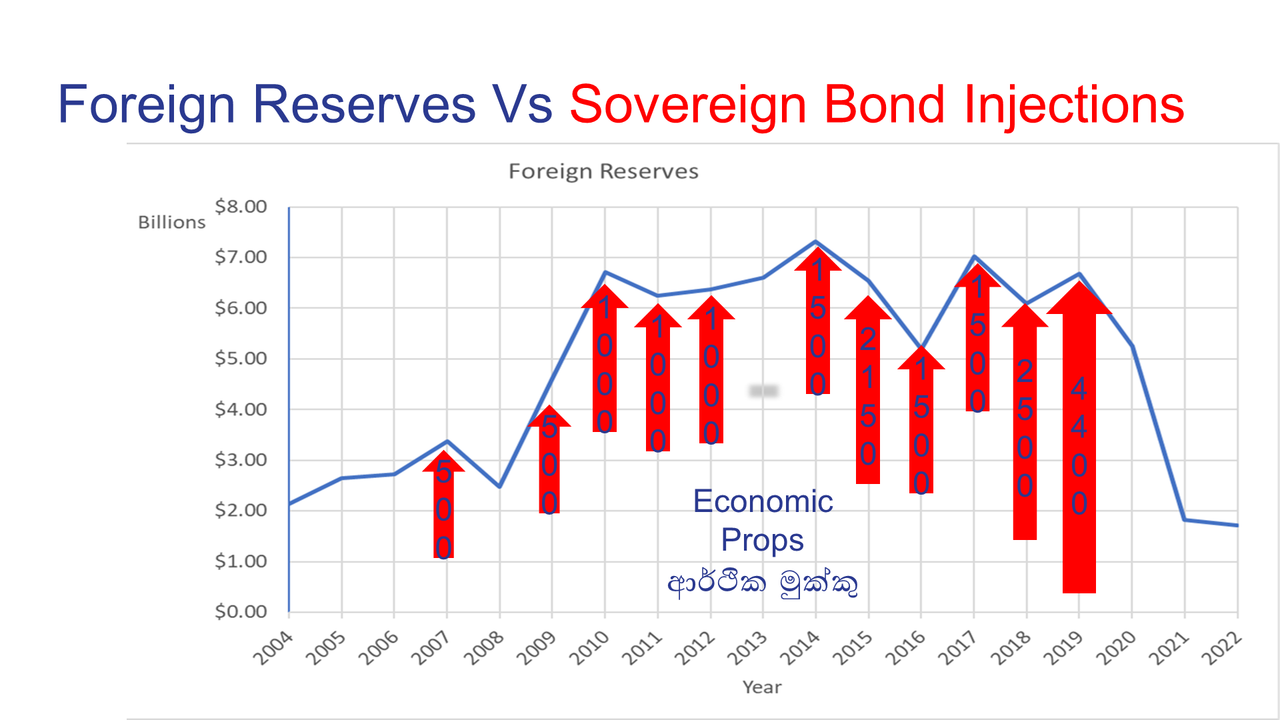
Ah! There we are! That makes things a lot clearer doesn’t it? 2007 was the year Sri Lanka started issuing sovereign bonds in international financial markets. We used these debts to finance our ever increasing trade deficits. That was how we had foreign currency to pay for our imports. Debt and borrowings were used to prop up our economy. These were the economic props that were used by all regimes since 2007, to pay for imports and prevent the Sri Lankan Rupee crashing against the dollar. In Fact the largest borrowing was done by Mr. Wickramasinghe when he was in power the last time.
Since Sri Lanka’s credit rating fell and our bonds could not be sold on the market, our reserves and consequently the Sri Lankan rupee started to nose dive. 7
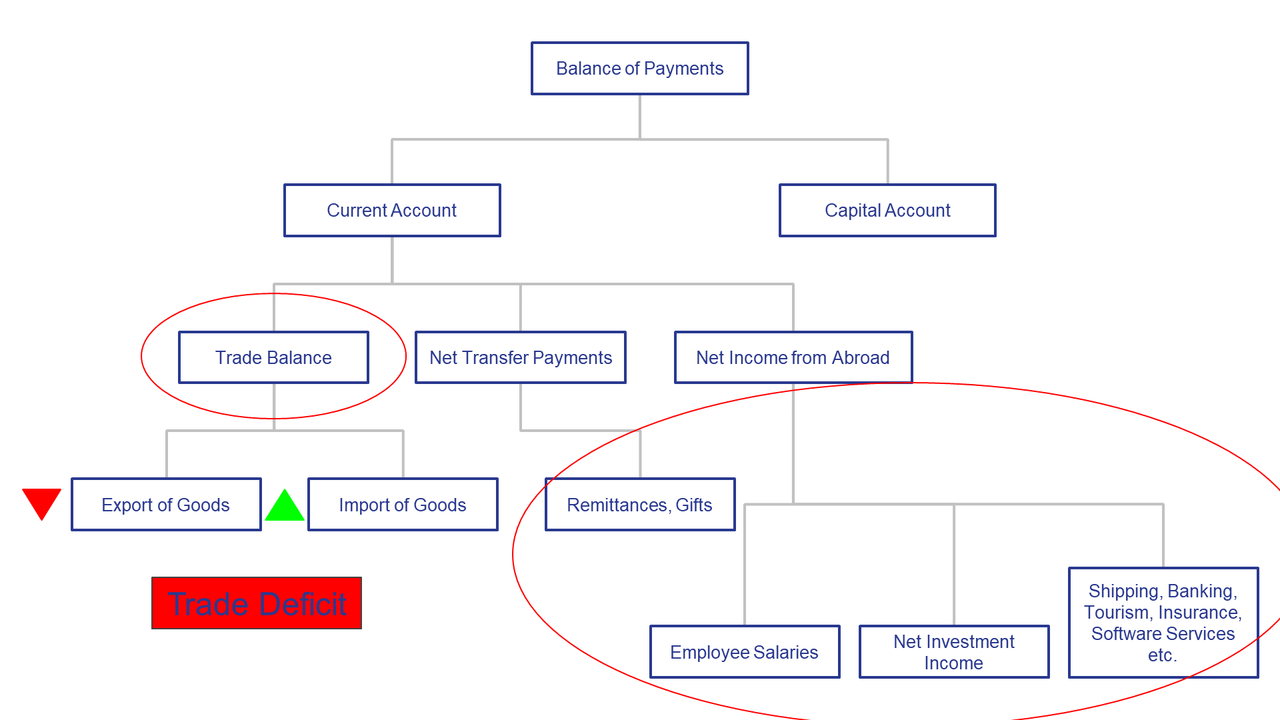
Sri Lankan politicians and elites realized that other incomes like remittances and tourism in our Current Account were not sufficient to pay for our trade deficit. So they decided to use our Capital Account.
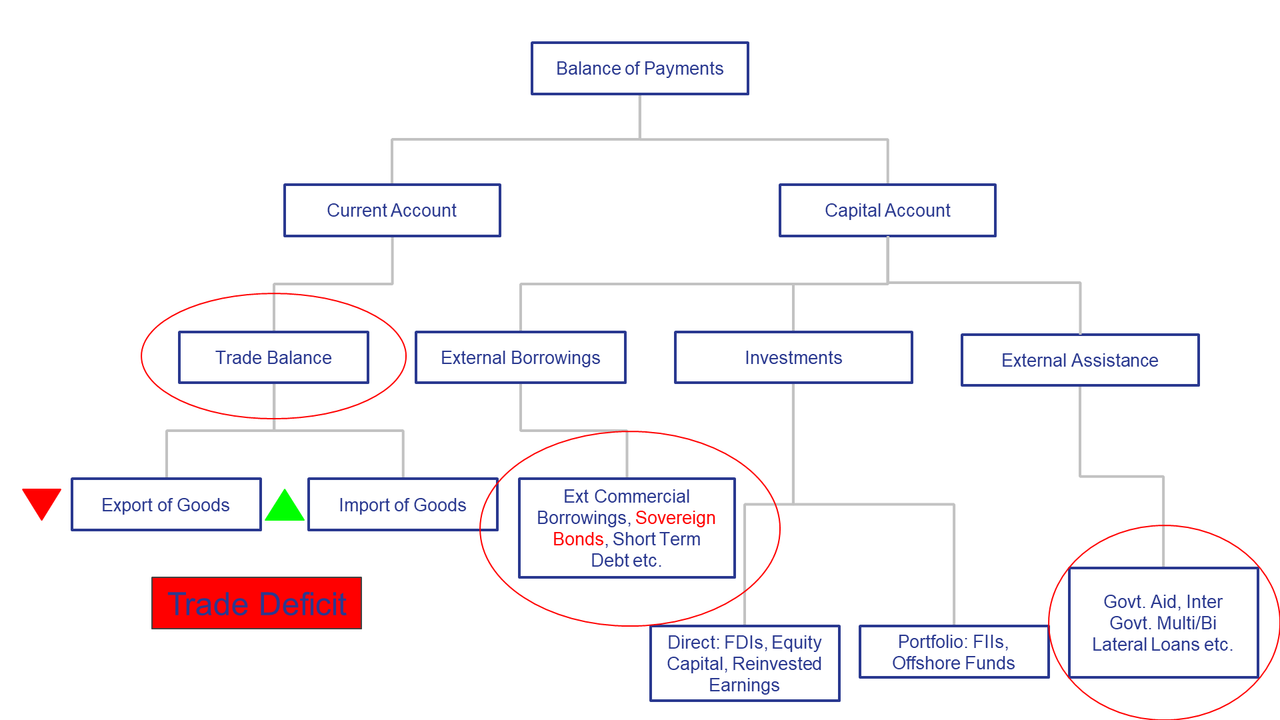
As you now understand, Sri Lankan elites decided to finance our Current Account Deficit, using money borrowed via our Sovereign Bonds. Of course they also used bilateral loans from the ADB, World Bank, India, China and Japan but we relied mostly on debt from Sovereign Bonds. So this is how we have been managing our economy since 2007. Even though we ran a Current Account deficit since 1977, we started using debt from Sovereign Bonds, International Banks and Bilateral loans to bridge the gap in our reserves caused by the Trade Deficit.
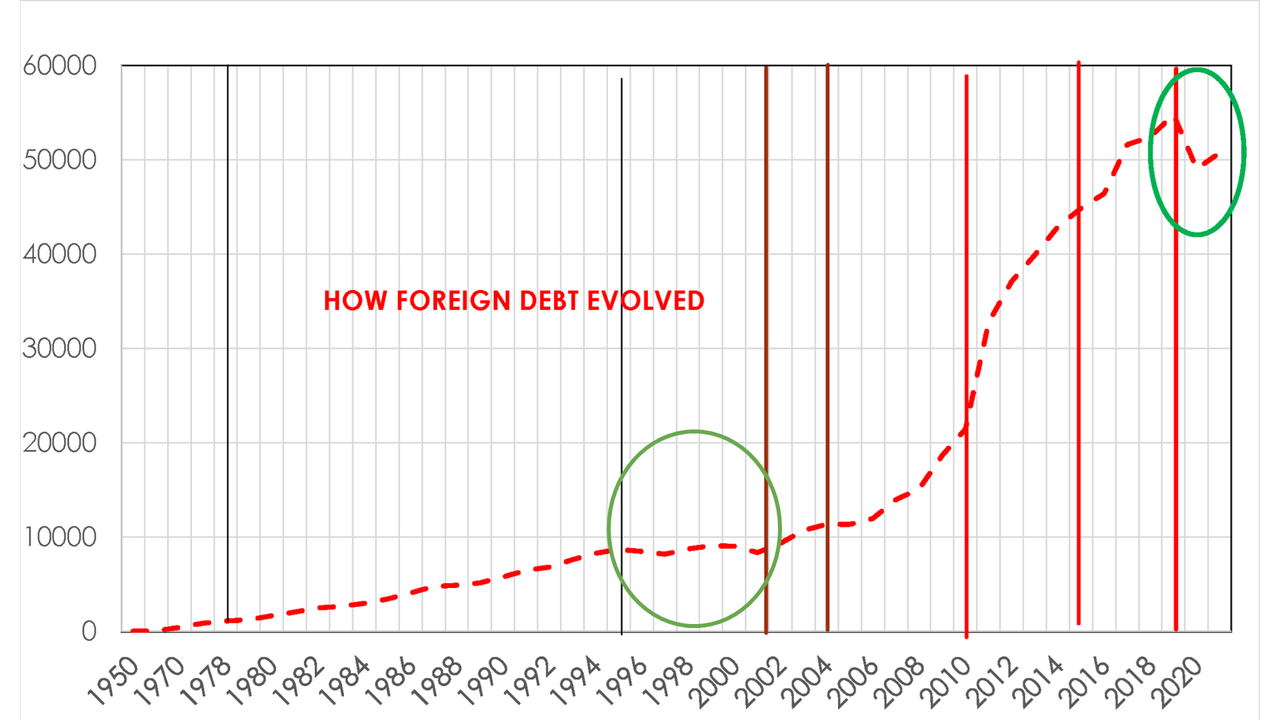
This graph shows us how Sri Lanka’s foreign debt has evolved over the decades. The green circle on the right shows that despite mostly valid criticisms leveled against the Gotabaya Rajapakshe regime, I give them credit for not resorting to further increasing Sri Lanka’s debt as method to overcome the crisis.
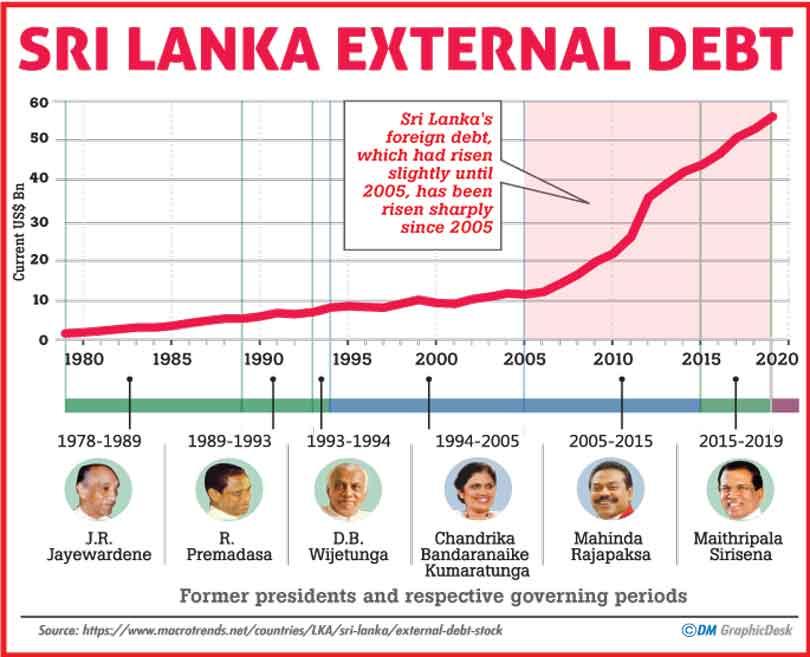
History has shown that ALL previous regimes resorted to debt to solve our balance of payment problems, while only the GR regime did not. They made some bad policy choices like banning nitrogen fertilizer and militarization of the vaccination drive but when it came to debt, only the GR regime began repaying the debt and tried decreasing it, instead of taking the easy route of borrowing ever further.
In hindsight if the GR regime actually increased our debt as previous regimes did in the past, there is a possibility that he would still be in power.
The green circle indicating the period between 1994 and 2002, was also a time when our foreign debt did not increase. Despite this Sri Lanka was still following the Neoliberal doctrine and was running a Current Account deficit. As it is now common knowledge, the Chandrika-Ranil regimes at that time oversaw a wave of privatization of State Owned Enterprises and State Owned Assets.
Conclusion
So putting it all together, Sri Lanka is facing a balance of payments disaster because it has been using a Neoliberal doctrine to create its economic policies since 1977. These policies have driven Sri Lanka to multiple economic catastrophes. Now our Elites and politicians are trying to find solutions to the current economic crisis caused by Neoliberalism using the same Neoliberal Framework.

This is the height of insanity and ignorance and it is why this series is titled “Our Elites Just Suck”. As Albert Einstein said, “Insanity is doing the same thing over and over and expecting different results.” Our Elites and the people that have been elected to govern us don’t have the simplest ability to even balance a cheque book. This is a skill that even someone who has completed his Ordinary Level exam has.
So in summary, how to ruin a country in 3 easy steps. If the situation wasn't so dire it would be funny how much this looks like a guide for greedy businessmen, politicians and elites to get rich off the backs of the working class.
- Step 1: implement neoliberal policies for about 45 years.
- Step 2, continually run a Current Account deficit and get bailed out by the IMF about 16 times not realizing/caring that neoliberalism itself is the issue.
- Finally, get debt from foreign nations, banks and financial institutions making Sri Lanka a slave to debtors. Oh! If you have any contingency plans for economic shocks, you’re making a mistake. No plan is the way to go.
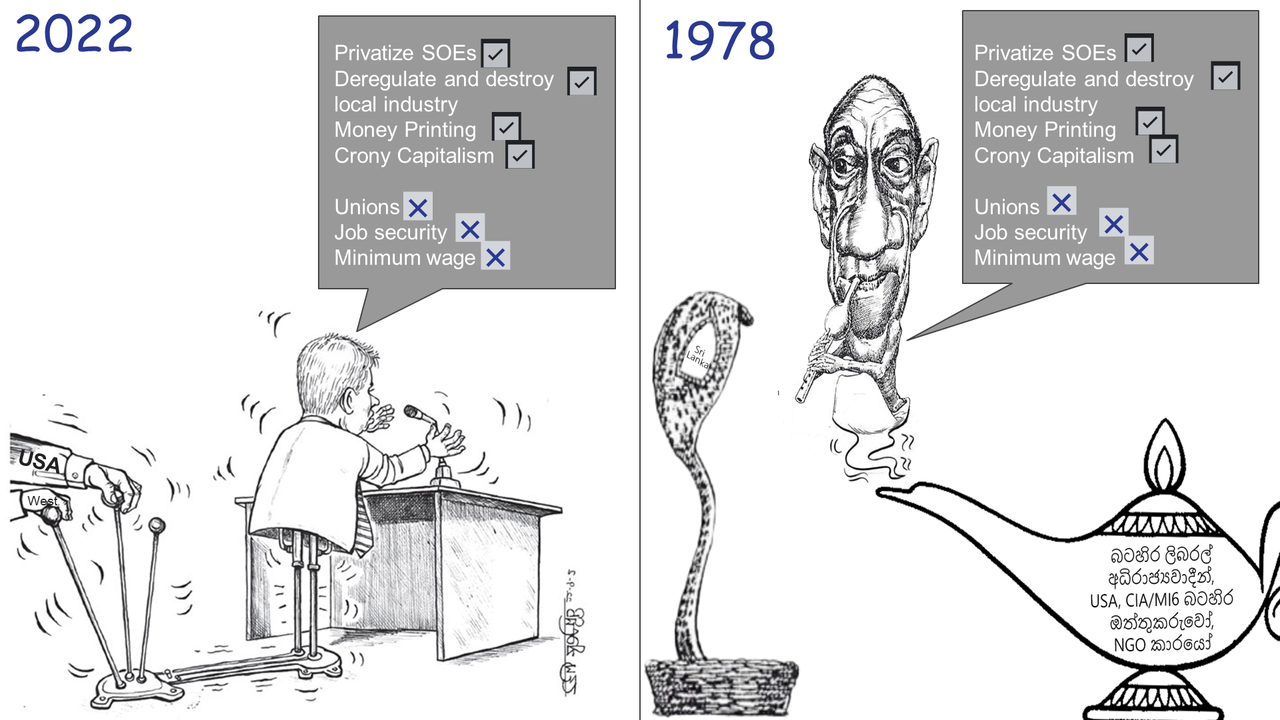
I highly doubt our Elites will ever wake up and realize Neoliberalism is the root cause of our problems and using it to solve our current calamity is going to be like adding fuel to the fire. Maybe try sharing this article or related video series with them. If they still ignore you and use the same old doctrine we can be sure that they have no patriotism to Sri Lanka and are willing to destroy the nation, just to be in power.
Notes
https://www.researchgate.net/publication/330651213_Sri_Lankan_Economic_Sovereignty_Insights_of_Potentially_Alarming_Trends↩
Manfred B. Steger and Ravi K. Roy (2010) Neoliberalism: A Very Short Introduction. Oxford: Oxford University Press↩
https://www.indiatoday.in/magazine/neighbours/story/19800815-jayawardene-prepares-to-use-the-full-force-to-quell-strike-called-by-trade-unions-821353-2014-01-28↩
Siri Gamage (2009) Economic Liberalisation, Changes in Governance Structure and Ethnic Conflict in Sri Lanka, Journal of Contemporary Asia, 39:2, Page 253, DOI: 10.1080/00472330902723824↩
7th International Symposium 2017 on “Multidisciplinary Research for Sustainable Development”. 7th - 8th December, 2017. South Eastern University of Sri Lanka, University Park, Oluvil, Sri Lanka. pp. 580-592. https://www.seu.ac.lk/researchandpublications/symposium/7th/Inaternational%20Symposium%202017%20-%20SEUSL%20(61).pdf↩
https://tradingeconomics.com/sri-lanka/foreign-exchange-reserves and World Bank Data: https://data.worldbank.org/indicator/FI.RES.XGLD.CD?locations=LK↩
https://www.dailymirror.lk/star-guide/SRILANKA-EXTERNAL-DEBT/313-235642↩